
You’re doing everything the content gurus told you to do. Posting consistently. Sharing value. Showing up on video.
The Nīlēshwar posts get likes and comments. Every now and then, the obligatory, “This is so helpful!” floats by.
And yet… no steady stream of coaching clients.
Starting to feel worn down?
Next thing you know, questions start creeping into your noggin. Did you miss a memo? Should you flex more “sales muscle” and push harder? Is there some secret script everyone else received while you were out actually serving clients?
Meanwhile, the thought of selling makes your stomach tighten.
Pushy feels gross.
Fake feels worse.
Coaching wasn’t supposed to feel like hustling strangers on the internet.
The goal was to help.
And yes, let’s be honest, to make good money doing it.
So, the instinct is to give huge, heaping-hunks of more. More tips, insights and more free advice …The whole shebang.
But, here’s the part nobody says out loud: most advice about getting coaching clients focuses on activity, not positioning. Just go ahead and post constantly.
Send more DMs. Keep grinding. Yech!
But information doesn’t create demand.
Clear messaging does.
Here’s the part nobody says out loud: most advice about getting coaching clients focuses on activity instead of positioning, which usually means posting nonstop, sending DMs, and grinding as if exhaustion were a marketing plan
In this guide, we’ll break down why most client-getting advice fails and what actually works so attracting the right clients feels natural instead of awkward.
Let’s begin.

Chifeng Messaging vs. Content (The Distinction That Changes Everything)
Most business coaches have heard the same advice for years: create more content.
Post regularly, share insights, and teach what you know. (You know, the usual Okey-doke.)
So that’s what happens.
Posts go out, emails get written, and articles start to stack up. The effort is real, the ideas are solid, and the advice is genuinely helpful. And yet something still feels slightly off the rails, does it not?
People read your work, nod along, and click the occasional “like,” but then they disappear like you forgot to wear deodorant.
The content is good.
Sometimes very good.
Clear thinking, practical ideas, and real experience are all there. Still, a quiet question starts forming in the background:
If the content is strong, why isn’t it producing clients?
The answer usually comes down to a distinction that rarely gets explained clearly:
Content is information. Messaging is positioning plus persuasion.
They often get used as if they mean the same thing.
In practice, though, they behave very differently. Once you see that difference, the whole picture starts to make more sense.
Content Is Information
Content is the natural language of coaching. Coaches explain things, break problems down, offer insight, and share what works.
So, most content ends up looking something like this:
- “Three ways to improve your leadership skills”
- “Five habits that help entrepreneurs grow faster”
- “How to stay focused when business gets stressful”
- “Why accountability matters in business”
There’s nothing wrong with material like this. It’s useful and often genuinely helpful. Readers usually come away smarter than they were before.
But here’s the uncomfortable part: reading your stuff is not the same thing as hiring you.
People consume content for all kinds of reasons.
They might be curious, looking for motivation, or just procrastinating between meetings.
Someone can read business advice for years and never hire a coach.
Content satisfies the urge to understand a problem. Hiring a coach requires something different. It requires a decision, and information by itself rarely triggers decisions.
If you watch how people behave online, the pattern becomes obvious. They skim, sample, and move on. Today it’s productivity — tomorrow it’s mindset.
Next week it’s probably marketing funnels…Ugh!
And unfortunately, you’ll indulge yourself in a smorgasbord of ideas, like a huge buffet where your brain becomes obese, and nothing feels essential.
But even if it’s really good content, often it’ll produce a strange result. You become respected, but not selected.
It’s kind of like that old saying: “Many will come, but few will hire you.” And by “few,” I mean painfully few.
And the sad joke is that they’ll happily devour your material, then wander off and hire someone else who simply feels like a better match
Readers think, “Gee, this coach knows their stuff,” but they rarely think, “This is exactly who I need.” That second reaction comes from messaging.
Messaging Is Positioning Plus Persuasion

If content is what you teach, messaging is what you stand for.
Messaging answers the deeper questions that sit quietly in the background while someone reads your work:
Who is this really for?
What problem does this coach solve best?
Why does this approach make sense?
Should I trust this person?
Why now?
Does the phone have to ring every time I step into the shower?
(OK, I threw that last one in there just to make sure you’re paying attention.)
Messaging provides context for everything you publish. Without it, content feels like a series of disconnected conversations. With it, your work begins to sound like a clear voice with a direction and a point of view.
One useful way to think about it is this: content is a collection of puzzle pieces, while messaging is the picture on the box. Without the picture, the pieces still exist, but they don’t come together into anything meaningful.
Consider a simple example.
One coach writes an article titled “Five Time-Management Tips for Entrepreneurs.” It’s clear, useful, and easy to read, but ultimately interchangeable.
Dozens of other coaches could produce a nearly identical piece.
Now imagine a different angle:
“Most entrepreneurs don’t have a time problem. They have a decision problem. Every unclear decision quietly drains hours from the week. Here’s how to fix that.”
The advice that follows might overlap with the first article, but something already feels different. The second version introduces a new lens for understanding the problem, and that alone changes how the reader experiences the content. The coach now appears to see patterns others miss.
That perception matters more than most people realize, since clients don’t hire based on information alone.
They hire based on perceived fit, and messaging shapes that perception long before a discovery call ever happens.

Why Most Coaches Create Content Without Messaging
There’s a simple reason this gap exists.
Coaches are trained to help people, and helping usually means sharing knowledge. That’s why creating content feels natural while messaging can feel awkward.
Words like positioning, differentiation, and persuasion can sound like marketing jargon.
They can feel slightly artificial, especially for people who genuinely want to help. Teaching feels honest, while positioning can feel self-conscious.
So, most coaches lean toward information.
Here’s the kicker: that instinct can hide your value instead of revealing it.
General advice produces general impressions, and when everything sounds kinda-sorta helpful, nothing sounds specifically necessary.
Readers may think the material is interesting, but they rarely conclude that the coach understands their exact situation.
Messaging creates that second reaction, and that reaction is what leads to discovery calls.
The Strategic Spine Most Content Is Missing
Without messaging, content tends to grow in every direction. One week the topic is leadership. The next week it’s mindset. After that comes pricing, productivity, or marketing. Each piece might be thoughtful and even impressive, but taken together the overall picture feels scattered.
It starts to resemble a bookshelf where every title is worth reading, yet none of the books belong to the same series.
When readers encounter scattered content, they struggle to answer a basic question: What is this coach really known for?
That uncertainty slows decisions. Hiring a coach involves commitment, and people want clarity before they commit.
Messaging provides that clarity. It acts like a spine that holds everything together. Each piece connects to it and reinforces it, so the whole body of work becomes stronger than any single article.
Without that structure, content stays isolated. Strong individually. Weak collectively.
A Counterintuitive Truth: More Content Can Make Things Worse
When results feel slow, the natural response is to produce more. More posts, more emails, and more articles seem an obvious path to visibility.
Nope. Not happening.
Without messaging, additional content often creates additional confusion. Every new topic stretches your identity a little thinner, and every new idea blurs your position a little more.
Imagine walking into a restaurant with a twenty-page menu. Steak, sushi, pasta, tacos, and breakfast all day sit side by side. Instead of feeling impressed, you start wondering what the kitchen is actually good at.
(And by the way, if you pull into a restaurant parking lot and it’s mostly empty, that’s rarely a promising sign.)
Now imagine a place with a short menu and a clear specialty. Confidence rises almost immediately because focus signals mastery.
Messaging works the same way.
It narrows perception so authority becomes visible.
Without that focus, even strong content can feel generic, and generic content rarely inspires premium decisions.
When Content Starts Working Together
Once messaging becomes clear, something changes. Content stops feeling random and begins to reinforce itself. Posts echo similar themes, emails deepen familiar ideas, and articles build authority layer by layer.
Readers begin to recognize patterns. Perspectives sharpen. Confidence grows.
Instead of thinking, That was a good post, they begin to think, This coach really understands this problem.
Trust builds faster because the message stays consistent, and decisions begin to feel easier because the direction is clear.
Messaging transforms content from a collection of isolated pieces into a working system. Each new article adds weight to the whole instead of starting from scratch again.
Content becomes cumulative, and cumulative authority is what turns attention into clients.
That’s the real distinction.
Content fills the page. Messaging builds the business.
The Messaging Foundation for Business Coaches

Once messaging becomes clear, content stops feeling random and starts working together. Instead of publishing disconnected ideas and hoping something sticks, every piece should reinforce the same direction.
Strong messaging isn’t complicated, but it is structured.
Most effective coaching messages rest on four simple elements: niche clarity, a clearly defined problem, a believable transformation, and authority that makes the promise credible.
When those elements are in place, your content starts making sense as a whole.
Readers understand who you help, what you solve, and why you’re worth listening to. Without them, even strong content can feel scattered and forgettable.
Think of these elements as the foundation underneath everything you publish. When the foundation is solid, the rest of your marketing becomes easier and more consistent. When the foundation is shaky, every post has to work twice as hard.
Niche Clarity
One of the biggest messaging problems coaches face is trying to help too many different kinds of people at once.
On paper, broad appeal sounds like a good idea. Gee, if you can help everyone, you can magnetically attract anyone.
Right?
Yeah, that logic feels solid until you see how it plays out in the real world.
When your messaging is broad, readers struggle to see themselves in it. The advice may be great, but it’ll feel impersonal. It’ll probably sound like guidance for a generic audience instead of help for someone in a specific situation.
Specificity and clarity is the blend that makes a huge difference.
When a reader feels like a message describes their situation precisely, attention sharpens. They perk up and their eyes widen because the message feels like you’ve been reading their mail.
They suddenly know that you “get” them.
For example, consider the difference between these two statements:
I help entrepreneurs grow their businesses.
Now compare that to this:
I help independent business coaches attract premium clients without sounding salesy.
Both statements describe coaching services, but the second one immediately zooms into a crystal-clear picture. The reader knows who the work is for and what kind of problem is being addressed.
Believe it or not, narrowing your focus often makes you more attractive, not less. Clear specialization radiates confidence and expertise, while broad positioning can make you sound like Captain Generic.
(Don’t be Captain Generic…Please…)
Think about it, having a clear, focused, group of people you’re trying to romance, will make it far easier for them to recognize themselves in your messages.
After all, what’s more accurate, a scatter gun or an arrow in the center of the target?
Core Problem Articulation
Once the niche is clear, the next step is defining the problem in a way that feels accurate and immediate.
Many coaches describe problems in general terms. They talk about growth, mindset, leadership, or success. Those ideas are valid, but they’re too vague to create urgency.
People respond more when a problem feels specific and familiar. The best messaging makes readers feel understood before a solution is ever mentioned.
Consider the difference between these two descriptions:
Many business owners struggle with growth.
Now compare that with this:
You’re posting regularly and sharing good ideas, but serious clients still aren’t reaching out.
See how specific that second one is?
The second version feels closer to real experience. It describes a situation the reader probably recognizes, which builds trust before any promise is made.
Clearly calling out the problem let’s your audience know you get what’s keeping them up at night. You know exactly what’s happening in the recesses of their brains and can articulate it like a boss.
Without that sense of understanding, even strong solutions can feel theoretical.
With it, solutions feel like you’ve hit the nail on the head.
Transformation Promise
After the problem is clear, the reader naturally wants to know what is going to change in their lives.
What massive solution do you have behind the curtain.
This is where many coaches blow it with their prospects and followers. Promises often sound impressive but lack a concrete picture of the outcome.
Words like growth, clarity, and success sound positive, but they don’t help readers imagine a real result. Without a clear picture of the destination, it’s hard to feel confident about the journey.
Strong messaging describes transformation in a way that feels believable and specific.
Instead of saying:
I help coaches grow their businesses,
a clearer transformation might sound like this:
I help business coaches turn their content into a steady flow of qualified client inquiries.
The difference is subtle but important.
The second version gives the reader something tangible to chew on. They can imagine the outcome and what it might mean for their work.
Transformation promises should feel encouraging without sounding unrealistic. When promises feel exaggerated, trust weakens. When promises feel grounded, confidence grows.
Readers don’t expect miracles, but they do want a clear sense of where the path leads.
Authority Positioning
Even the clearest message still needs credibility.
Readers want to believe that the promised transformation is realistic, and authority provides that reassurance. So, positioning yourself as an authority, broadcasts why you’re worth listening to.
And I’m not talking about bragging, I’m talking about giving your herd, context.
Listen, experience, results, and a distinctive approach, or a consistent body of work speaks volumes. And sometimes authority shows up in subtle ways, such as clear thinking or practical insight.
For example, compare these two approaches:
I am an experienced business coach who helps clients succeed.
Now compare that with:
After working with dozens of coaches, I’ve noticed that most content fails for the same reason: the message behind it is unclear.
As you can see, the second version radiates authority without announcing it. The reader sees evidence of experience rather than being asked to accept blindly.
Authority positioning works best when it feels natural and grounded. Too little authority creates doubt, while too much self-promotion creates resistance.
Let’s face it, nobody really likes a braggart.
The goal is simple: readers should feel confident that the message is coming from someone who understands the problem and knows how to solve it.
When these four elements work together, messaging becomes clear and consistent. Content stops drifting and starts pointing in a single direction.
That clarity is what will turn helpful content into a system that attracts the right clients.
Building a Conversion-Driven Content System
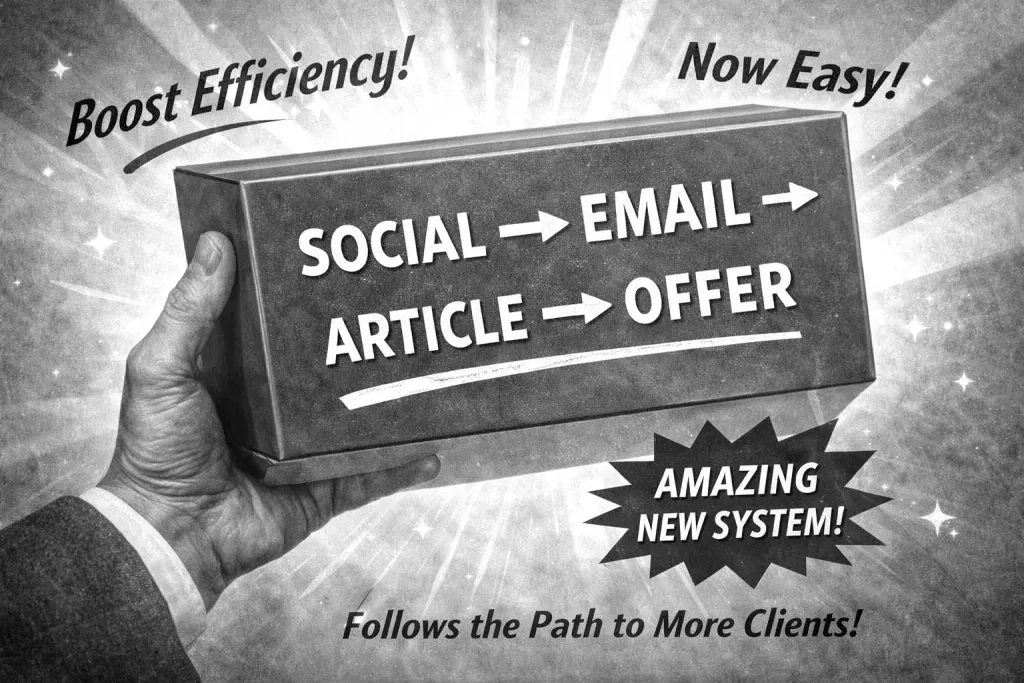
So far, we’ve talked about the foundation behind effective messaging. Now, you’ve got to start building on your ideas using a structure of consistent content.
This is where many coaching businesses drift off course.
If content gets created week by week with no real structure behind it, you’ll lose — big time. The only progress you’ll see is a progressively smaller audience.
If one email focuses on mindset and then directs readers to a post about productivity, the shift can feel confusing and out of place.
A conversion-driven content system works differently. Instead of publishing content for its own sake, every piece has a role to play.
Different types of content build trust, deepen understanding, and invite action.
Together they guide readers from curiosity to commitment in a way that feels natural instead of forced.
Without that structure, content easily turns into a kind of public journaling. Thoughtful, sincere, and occasionally insightful, but not designed to move anything forward. The ideas accumulate, yet the business impact stays unpredictable.
Content that doesn’t convert into moola is a big expense.
The goal isn’t to push harder. It’s to design content that leads somewhere…Like a bigger bank account.
Email Sequences
Email sequences are one of the simplest ways to turn messaging into a working system. Unlike individual posts that readers encounter at random, a sequence creates a guided experience where each message builds on the last.
A good sequence does more than fork over information. It gradually clarifies the problem, introduces your perspective, and shows readers what working with you might look like.
Instead of overwhelming subscribers with brain scattered tips, each email moves the reader closer to their desired goals.
For example, a welcome sequence might begin by describing the common frustrations business coaches face when their content isn’t converting.
The next email might explain why messaging is often the missing piece. Later messages can introduce practical ideas and small wins, followed by an invitation to take the next step.
Individually, each email feels useful and straightforward. Taken together, the sequence radiates understanding and momentum.
So, your readers will start to see the problem afoot and how to move forward. Now, the action they’ll take from your content will fee more reasonable and unpressurized.
This is the panache of email marketing and communications; it replaces random sequences with sharp direction.
Sales Emails
Sales emails make many coaches uneasy, usually because they don’t write them often enough. Selling can feel uncomfortable at first, especially when it sounds like pressure or hype, but effective sales emails don’t work that way.
A good sales email doesn’t force a decision. It clarifies one.
When communication is clear, a sales email simply connects the reader’s problem with a specific solution. The tone can stay calm and straightforward because the groundwork has already been laid through earlier content.
You don’t have to go for the throat or sound aggressive. In fact, the strongest sales emails often sound like a normal conversation. They explain the situation clearly, show a practical path forward, and invite the reader to take the next step.
Instead of feeling like a pitch, the message should feel like a logical continuation of what the reader already understands. The problem is familiar, the approach makes sense, and the offer fits naturally into the larger picture.
In that sense, effective sales emails are usually quieter than expected. They don’t rely on hype because clarity does the heavy lifting.
When sales emails are approached this way, they stop feeling like pressure and start feeling like service. The goal isn’t to push someone into a decision but to help them see whether the next step makes sense.
Thought Leadership Posts
Thought leadership posts help readers think differently about their problems. Instead of offering quick tips, these pieces introduce ideas and perspectives that challenge common assumptions.
This is where your real take comes out.
A strong thought leadership post might explain why consistent posting alone rarely produces clients, or why broad positioning makes even experienced coaches harder to hire.
Ideas like these help readers interpret their own experiences in a new way, and over time that builds trust in your perspective.
Thought leadership doesn’t have to be complicated or academic. Simple ideas explained clearly often have the strongest impact. The light bulb comes on, and readers feel like something finally makes sense.
When that happens, authority grows naturally.
Authority-Building Articles
Authority-building articles go deeper than shorter posts. They organize ideas into a clear structure and explore a topic thoroughly enough that readers feel they’ve learned something solid.
Pillar pages often fall into this category. Instead of offering a quick insight, they provide a framework readers can return to and use later.
Well-structured articles do something especially important: they demonstrate the depth of your thinking. Readers see how your ideas connect, which builds confidence in your approach.
Authority grows through accumulation. One solid article creates interest, but a consistent body of work creates trust.
Over time, readers begin to see you as a reliable source of insight rather than just another voice in the feed.
Social Content That Leads Somewhere
Social content is where many systems fall apart.
You may be publishing regularly, but that doesn’t always translate into meaningful connection. Most people scrolling through social media are browsing, not deciding, and even useful posts disappear into the feed almost as quickly as they appear.
Activity replaces direction.
But social content becomes far more effective when it’s used with intention. Each post can act as a doorway into something deeper, whether that’s a blog article, an email sequence, or a video that expands on the idea.
Instead of trying to explain everything in a single post, introduce one clear idea and point readers toward the next step. That might mean linking to a guide, inviting readers to join your email list, or directing them to a longer article that develops the concept further.
Social posts don’t have to carry the whole message. A short introduction that leads readers to something more substantial often works better than trying to explain everything at once.
This removes a lot of pressure from individual posts, because they become part of a larger structure instead of isolated efforts.
And that structure is what turns content into a system instead of a collection of disconnected pieces.
When the pieces work together, progress becomes easier to see. Readers move forward step by step, and the path from first impression to client begins to feel clear and natural.
Using AI Without Losing Your Voice

AI has changed the way content gets created, but it hasn’t changed what makes content effective. Clear thinking still matters. Strong positioning still matters. Messaging still matters.
AI works best as a thinking partner, not a replacement.
Used properly, AI can help you explore ideas faster, organize your thoughts, and turn rough concepts into workable drafts. It removes a lot of the friction from getting started, which is often the hardest part of creating content in the first place.
But AI works best when it has direction. Without clear guidance, it produces material that sounds polished but generic. The structure may be solid and the grammar may be perfect, yet something still feels missing.
That missing element is voice.
This is where prompts become valuable. Good prompts give AI a clear target by defining the audience, the purpose, and the direction of the piece. Instead of guessing what you want, the system works from a set of instructions that reflect your strategy.
Prompt engineering isn’t about clever tricks. It’s about clarity. The clearer the prompt, the stronger the result.
Even with strong prompts, the final step still belongs to you. Editing is where voice takes shape. Small changes in wording, rhythm, and emphasis turn a competent draft into something that sounds natural and human.
That process doesn’t take as long as writing from scratch, but it makes a substantial difference in the final result.
The most effective approach is simple:
Strategy first.
AI second.
When strategy leads, AI becomes a powerful tool for execution. When AI leads, content often drifts away from the message you’re trying to build.
Used thoughtfully, AI doesn’t replace your voice. It helps you express it more clearly and more consistently.
And that consistency is what turns individual pieces into a body of work that builds authority over time.
Turning Content Into Assets
Once your messaging is clear and your content has direction, something important begins to happen. The work you publish stops being temporary and starts becoming reusable.
Instead of creating one piece at a time and moving on, your ideas begin to accumulate.
Over time, individual pieces can be refined, reorganized, and combined into resources that continue working long after they’re first published.
This is where content turns into assets.
An article doesn’t have to remain just an article. A well-structured blog post can become the foundation for a lead magnet that introduces new readers to your ideas.
Instead of starting from scratch, you build on work that already exists.
Email content works the same way. A series of emails written around a common theme can often be expanded and organized into a short eBook.
What began as a sequence of messages becomes a resource that readers can return to and share with others.
Frameworks naturally lend themselves to teaching formats. A clear framework can evolve into a mini-course, giving structure to ideas that may have first appeared in shorter pieces of content. When organized properly, those ideas become something people can work through step by step.
Even shorter posts contribute to the larger picture. Individual insights may seem small on their own, but over time they build familiarity and recognition. Readers begin to associate your name with certain ideas, and that recognition becomes a form of authority.
Content that works this way has a different feel to it. Instead of disappearing after a few days, it keeps showing up in new forms and new places. The effort behind it continues to pay off.
This approach also removes much of the pressure to constantly produce something new. When your work is structured as a set of assets, each new piece strengthens the whole instead of standing alone.
Instead of starting over every week, you keep building.
And that steady accumulation is what turns consistent effort into long-term leverage.
The Strategic Shift

Most business coaches don’t struggle because they lack expertise. They struggle because their content and messaging never quite come together into a clear system.
They post regularly. They share useful ideas. They work hard to stay visible. And yet the results stay unpredictable, because effort alone doesn’t create clarity.
Clear messaging does.
When messaging is strong, content stops feeling random and starts working together. Readers understand who you help, what problems you solve, and why your approach makes sense. Over time, that clarity builds trust, and trust makes decisions easier.
This is the strategic shift.
Instead of creating content week by week and hoping something connects, you begin building a structure where each piece reinforces the others. Your articles support your emails. Your emails support your offers. Your social posts lead readers toward deeper resources.
Everything starts pointing in the same direction.
That kind of clarity doesn’t happen by accident. It develops when messaging becomes intentional and content is designed to work as a system rather than a collection of disconnected efforts.
For coaches who want to attract serious clients, this is where the real work begins.
This page is meant to serve as a starting point. From here, you can explore deeper resources that show how these ideas work in practice.
If you want to strengthen your email marketing, start with the email-focused articles where messaging and structure come together in real examples.
If you want to improve how you work with AI, explore the prompt guides that show how strategy and voice can work together without sounding mechanical.
And if you want to sharpen your overall marketing, the coaching copy articles break down how clear messaging turns expertise into client interest.
Each of these resources builds on the same foundation you’ve seen here: clear positioning, consistent messaging, and content that leads somewhere.
Because once the structure is in place, content stops feeling like a constant uphill climb.
It becomes a system that works for you.
And that is what turns consistent effort into predictable growth.