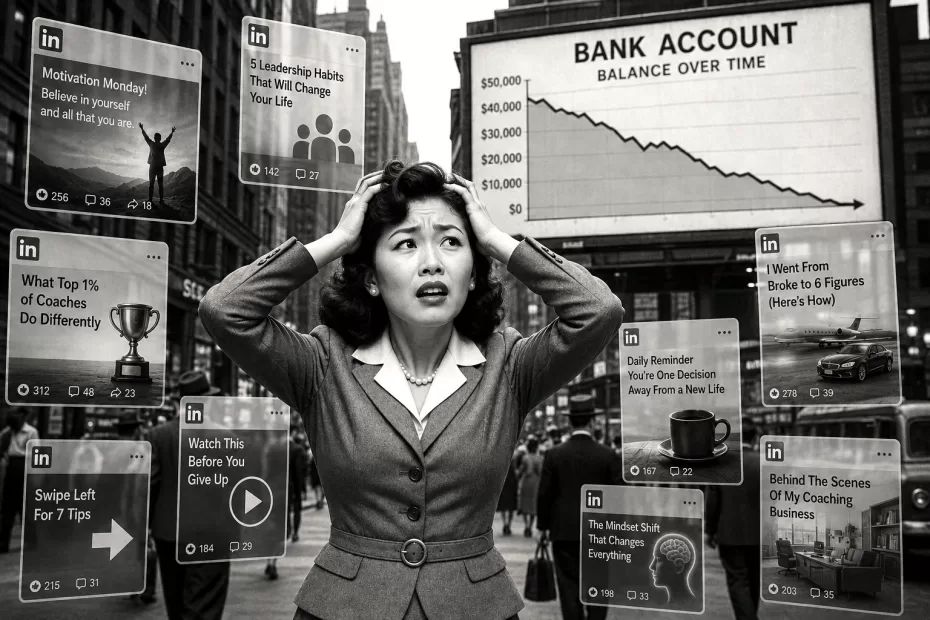




The biggest problem with marketing for coaches isn’t a lack of content. It’s that most of that content never turns into paying clients.
If you’re in the coaching business, you’ve spent time on LinkedIn.
And if you’ve spent time on LinkedIn, you’ve seen coaches posting content nonstop.
Motivational stories, carousels, and videos are everywhere. And sure, they’re getting all kinds of attention from their followers and fans.
But here’s the thing.
Is all that attention actually translating into clients willing to plunk down good money for their services?
Yep, “likes” aren’t sales and comments aren’t contracts. Just because a coach is highly visible doesn’t mean they’re hired.
Just sayin’.

Welcome to the Dopamine Casino of Social Media
You’ve probably heard this before, but it’s worth repeating.
Social media platforms are designed to keep you using them.
In many ways, they’re built around the same reward systems that keep people feeding money into slot machines in Las Vegas.
Every time someone gets a like, comment, share, or notification, the brain receives a little reward. It feels good. That’s why people keep coming back for more.
Researchers have been warning about this for years, yet social media companies continue spending enormous amounts of money studying human behavior and finding new ways to keep users engaged for as long as possible.
And yes, it works.
I recently discovered I was spending at least an hour a day watching YouTube Shorts.
An hour gone. Boom! Just like that.
So even when you’re aware of what’s happening, you can still get sucked in.
Ugh.
It’s the Same for Content Creators
Now don’t think that because you’re producing content instead of consuming it, you’re somehow immune.
You’re not, because the platforms have figured out how to hook content creators too.
Will it get likes, comments, or shares?
Sure.
Will it go viral and suddenly flood your calendar with paying clients?
Not bloody likely!
And the next thing you know, you’re checking notifications all the time, which is another time-suck.
Before long, it’s just like playing a one-armed bandit in Vegas. You’re hooked.
(Good luck with all that!)
Every now and then you’ll get rewarded with a post that takes off and you’ll get your dopamine boost. Then you’ll want more attention, more engagement and more followers.
Yep, you’ll really be addicted.
(There’s a reason why drug pushers give out drugs for free…At first. The business model is different, but the psychology isn’t.)
So, you create more content.
And the platform owners smile all the way to the bank because you’re doing the work for them for free.
Here’s the problem: none of this activity helps you pay the bills.
Likes don’t pay the mortgage, and comments won’t fund your retirement.
Having money come in, consultations booked, and clients signing contracts is what matters in business.
Think of it this way:
If you’re getting a thousand likes and hundreds of comments, what good are they if no moola is rolling into your bank account?
A thousand likes from people who never buy anything still equals zero clients.
Right?
Why “Just Post Consistently” Is Incomplete Advice
Of all the social media sites I frequent, I hop onto LinkedIn.
And I’m the kind of person who sees patterns in people’s behavior. I’ve noticed that most of the social media gurus on that platform dish out the same advice:
• “Just keep posting.”
• “Stay visible.”
• “The algorithm rewards consistency.”
• “Success is a numbers game.”
There is some truth in all of those statements.
However, many top-tier coaches are playing a different game. They’ve spent years building their businesses and have resources that most new coaches don’t.
Some even hire ghostwriters to create content for them.
If you’re just starting out, you can’t afford to play that game.
However, the one thing you can learn from them that’s powerful is this:
Consistency matters.
The downside to this is that consistency alone is not a strategy.
The problem is that consistency only works when it’s pointed in the right direction.
Take a Lesson From a Beaver
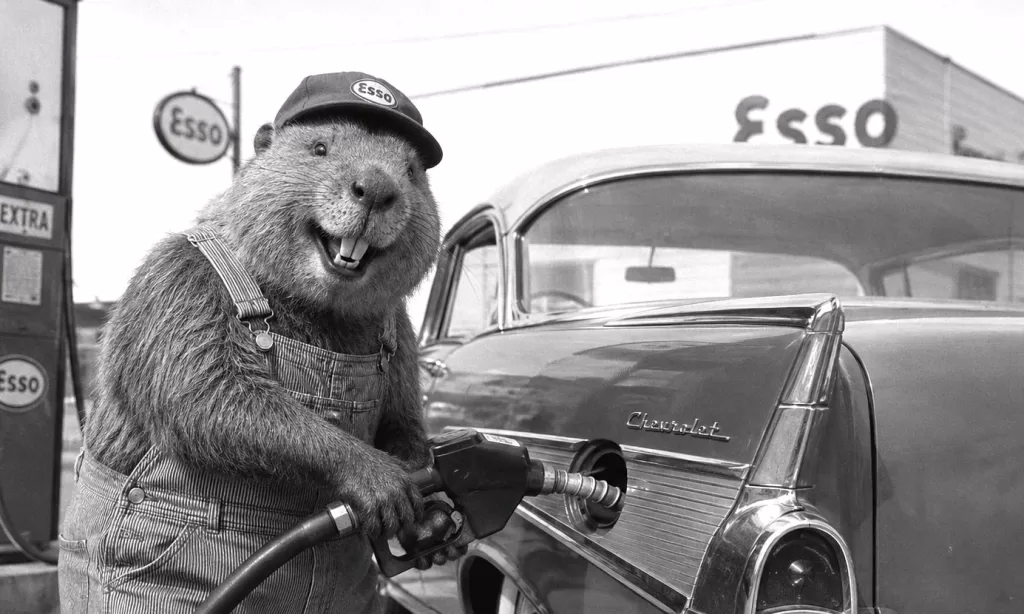
If you’ve driven on just about any of the Interstate roads on the East Coast, you’ll see billboard signs for a mega-sized travel center named Buc-ee’s.
I swear to you, they have billboard signs every 20 miles or so featuring a dorky beaver mascot wearing a cap.
(And they have some of the funniest slogans I’ve ever seen. “You can hold it – Buc-ee’s 171 miles ahead.”)
Anyway, if you’re driving on roads away from the Interstate, you won’t see a Buc-ee’s sign anywhere.
They cleverly put those insane things where they know their most likely customers are. In other words, they’re placing their signs strategically where their hot prospects are.
They aren’t trying to reach everybody. They’re trying to reach people who are already headed their way.
So, Buc-ee’s has a posting strategy, and so should you.
Posting every day without a clear message is like putting up hundreds of billboards in the desert. Sure, you’re creating visibility, but darn few are going to pay attention.
The Factors a lot of Coaches Miss
What often gets left out of the conversation are the factors that actually make content effective:
• Messaging
• Positioning
• Emotional resonance
• Audience psychology
• Trust-building
• Relevance
These are the things that determine whether people stop scrolling, pay attention, and plunk down money to work with you.
Here’s the frustrating part: the Internet is full of experienced coaches who have been posting for years.
Many of them show up every day, publish content, stay visible, and still struggle to grow their business.
Why?
Because merely being consistent isn’t enough.
If what you’re saying is confusing, generic, and forgettable, consistency is nothing more than the same muck everyone else is churning out.
Think of it this way: a loudspeaker doesn’t improve a message. It only amplifies it.
That’s why “just post consistently” is crappy advice.
Yeah, it’s important, but it should come after strategy, not before it.
A coach who understands their audience, communicates compelling messages, and creates content with emotional impact can often outperform someone posting three times as much content.
You don’t want to become a content machine; you want to become memorable.
Because in a crowded marketplace, people don’t buy from the person who posted the most.
They buy from the person who understands them.
The Internet Is Drowning in Forgettable Content
Yeah, read the subhead above and weep. And the sad part is that many people can’t even remember what they posted last week.
So, here’s the thing: if you can’t remember what you posted, then how can you expect anyone else to remember them?
Go ahead, scroll through a social media site and you’ll start noticing it yourself; the same stuff repeated over and over again.
Believe in yourself…Stay consistent…Trust the process…Great things are coming…Blah…Blah…Blah…
Essentially, those kinds of statements are OK, but they’re as plain as a baloney sammich without mayo.
Totally vanilla and totally boring.
And it’s the same with “5 Tips” posts, motivational quotes and “empowerment” messages. They sound important, but don’t actually bring in the revenue.
Those posts might get a few comments, but they melt away like a snowflake in Florida.
Why?
Because people remember stories, strong opinions, and observations.
You know – there’s a human element in their messaging that hits you in your heart.
And if you can make them laugh, nod their heads and think, “Man, this coach really gets me!”
But if you keep posting the same recycled okie-doke they’ve seen every day, over and over again, they’ll never come back.
So, don’t be boring. Take a position, get specific, and disagree with the status quo.
People remember mavericks not conformists.
At the end of the day, the Internet doesn’t have a content shortage — it has a memory problem.
So, if you want to build a coaching business, learning how to be remembered is more valuable than getting people to notice you for a few seconds.
The “Infinite Treadmill” Trap
This is where coaches get into a sticky wicket.
When people can’t remember your content, you have to keep producing more of it to stay in their view.
I know what you’re thinking.
You’re thinking that if top dogs like Tony Robbins are posting everywhere and all the time, so should I.
Right?
I mean they keep posting like crazy and bow down to Google’s algorithm, and it’s working for them.
So, you think, “that’s what I should do.”
Nope.
Tony Robbins started out in the 1970s and I remember his original message clearly:
“I was a poor guy, living in an apartment so small that I had to wash my dishes in my bathtub. If I can successfully pull myself out of that, so can you.”
Yep, saw that on TV and never forgot it, and he ran with that for years.
That’s content that people will remember.
Now, Tony Robbins is a giant in his industry. Like Coca-Cola and Progressive Insurance, he can afford to be seen everywhere all the time.
However, that’s not an option for most coaches, and you have to rely on the power of your words.
So, consistently posting everywhere all the time isn’t the solution, my friend.
The problem is that your message isn’t sticking.

Memorable Messaging – The King of Effective Content
You must have content that will remain in the minds of your readers, so they will come back to you.
You need messaging that is creative and will reinforce the same ideas over and over again to your readers. If it’s something that can change their lives in a positive way, they will remember it.
And that is memorable messaging.
Every post, meme, or story you produce must reinforce the core ideas. Instead of starting from zero every day, you’re building on what people already know.
Clients and prospects don’t buy from coaches who post the most.
They buy from a mentor who can deliver results.
And that’s why you must create content that builds on ideas people will remember.

7 Content Hacks That Will Make You Memorable
OK, I’m sure you’re wondering, “what kind of content should I produce that will make me memorable?”
Well, don’t despair, because here are 7 ways to write content that will get the job done.
So, if you do this right, you’ll be remembered and sought out.
Just sayin’.
Here they are, from the least to the most effective:
Frameworks
As a coach, you already know the importance of frameworks. They are vital to organizing information that people can digest. However, most of them are about as memorable as last week’s grocery list.
Think about how many “7 Steps to Success” you’ve seen over the years. Most people don’t remember the frameworks that were used.
They remember the stories, examples, and experiences that brought those frameworks to life.
Specific Examples
Specific examples are better than advice. Anyone can toss out advice to a group, but in the mind of the reader, those ideas can be vague.
Specific examples are much easier to understand and are relatable to your crowd. However, they are rarely going to leave a memorable impression.
Strong Opinions
Your opinions are annoying to those of us who already know everything. (I kid! I kid!) They are great at getting attention and making you stand out from the crowd.
But strong opinions can feel like noise if they aren’t backed up with evidence.
Contrarian Observations
A contrarian observation is an overlooked device that is usually right in front of your face. (There, I made one!) It is stronger than an opinion because it is linked to an insight and usually works because it makes people reconsider what you’re saying.
Example:
“The internet doesn’t have a content shortage. It has a memory problem.”
Now, that’s contrarian and memorable.
Personal Experiences
If you want to make a memorable impression, then throw a personal experience at your crowd.
It’s powerful because it is relatable. Your readers are walking in your shoes, reliving your experience in their minds. When this is done right, it creates a bond between you and your followers.
And the best part?
It answers their question, “Why should I listen to you?”
Emotional Moments
People will forget what you said or did, but they’ll never forget how you made them feel. Emotional messaging creates some of the longest-lasting memories in your tribe.
However, you don’t need to bring your readers to an emotional peak every time you write something. If you can just move the meter to moderately emotional, that’ll help.
That emotional connection creates an anchor between you and your followers, making your message much harder to forget.
Stories
Stories are vital because people won’t remember boring facts. There, I said it!
People love imagining themselves in what they are reading, and that’s what makes stories the rock stars of the content world. Go ahead, throw one at your readers sometime. Even if you’re lousy at telling stories, they’ll relate to the struggle, emotion, and outcome far better than a pile of information.
So there it is, the top 7 content hacks you can use to build your coaching empire.
The Real Goal Isn’t More Content
To sum this up, coaches don’t have a content problem but a memory problem. The Internet has crap-loads of advice, from tips to motivational quotes. And hopeful coaches hit the “Post” button every day praying their content will change the universe and make them famous.
Probably not gonna happen, Bochombo.
It’ll disappear into the digital abyss.
Why?
Because nobody will remember the bloody thing!
The coaches who consistently attract more clients and prospects are saying things people remember. They’re creating content that sticks in the minds of their readers long after they’ve read it.
Now, that’s the real deal.
The goal isn’t to be more visible, get more likes, or become a hamster on an infinite treadmill.
The prize is to become memorable.
Because when people finally decide they need help, they won’t hire the coach who posted the most content. They’ll hire the coach who made them think, laugh, and feel understood.
So keep posting.
Stay persistent.
Stay consistent.
And always show up to reinforce your core message.
Because the Internet doesn’t have a content shortage.
It has a memory problem.
And the coaches who solve that problem are the ones people remember.