



If you’ve ever had to raise money for a private school, you know it can feel like trying to pull teeth—with a plastic spork.
Parents, staff, and even local business partners tend to tune out fundraising efforts not because they don’t care, but because they don’t see why it matters to them.
Or worse: they mean to help… then forget.
That’s why a clear, compelling private school fundraising letter can make all the difference.
In this post, I’ll show you exactly how to write a private school fundraising letter that grabs attention, motivates action, and brings in the cash your school needs.
Let’s dive in.

Let’s Dissect This Private School Fundraising Letter Together
What follows is a detailed breakdown—by the numbers—of what makes a private school fundraising letter effective. This isn’t guesswork. Just like writing advertising copy, there’s a method to the madness. Certain elements must be presented in a specific, logical order to capture attention, build interest, and inspire action.
IF YOU WANT TO READ THE FULL SALES LETTER, HERE IT IS :PRIVATE SCHOOL FUNDRAISING LETTER
Think about this: the average person is bombarded with hundreds—sometimes thousands—of marketing messages every day. Why should they stop and pay attention to your letter?
The answer: because you’ll write it differently.
This detailed dissection will walk you through the exact steps to write a private school fundraising letter that actually gets results. Whether you’re trying to engage parents, local business owners, or alumni, this approach will help you craft a message they’ll read—and respond to.
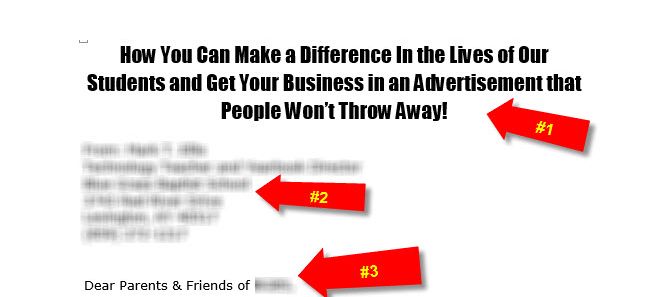
The Letter by the Numbers…
#1 – Lead with a Killer Headline
The headline is everything. In fact, most top-tier advertising copywriters spend up to 80% of their time crafting the perfect one.
Why?
Because you only have a few seconds to catch your reader’s attention. If the headline flops, the rest of your message might as well be printed on invisible ink.
So – what makes a headline work?
To break through the noise, your headline must:
- Present the biggest, boldest benefit
- Spark curiosity that demands a closer look
Let’s break down how the letter we’re analyzing kicks things off—and why it works.
This private school fundraising letter was used to promote advertisement space in a school’s yearbook. The school was having a hard time getting businesses to respond to the opportunity of getting their businesses into the yearbook.
When I wrote this piece, I sat down for a couple of hours and really brainstormed the top benefits I could present to businesses and parents that wanted to advertise in the yearbook.
Since I had a severe time constraint, I had to spend less time than usual on this. The headline is super important, so usually, when I write a piece for someone it takes a lot more time.
However, this letter had to be done quickly. (By the way, I normally won’t do work that requires this fast of a turnaround. Solid ad copy requires a lot more time and effort.)
In this headline (#1) I presented two benefits.
- Making a difference in the lives of the students at the school
- Getting businesses ads in a publication that won’t be thrown away
Features vs. Benefits: What’s the Difference?
Understanding the difference between features and benefits is one of the most important lessons in writing a private school fundraising letter.
Features describe what something is—like its size, color, or format. Benefits, on the other hand, explain what it does for the person reading your letter.
A benefit might be “helps your business gain visibility” or “supports students going on a senior trip.”
In the example headline we looked at earlier, I included two powerful benefits: making a meaningful difference in students’ lives, and promoting a business through a printed yearbook that won’t get tossed out with the junk mail.
Those are compelling reasons for someone to get involved—especially for business owners connected to the school who care about its mission.
I could have chosen a simpler angle, like telling parents they’d get to see pictures of their kids in the yearbook.
But I wanted something with more emotional impact and broader appeal, particularly for businesses that support the school’s Christian values.
Even the phrase “Get Your Business in a Publication that People Won’t Throw Away!” works as a benefit. It builds curiosity and drives people to keep reading.
Notice I didn’t say outright that it was a yearbook ad—I wanted to pull them in first.
#2 Who Is This From, and Why It Matters
In most types of advertising, including a formal sender line isn’t usually necessary. But a private school fundraising letter is different.
If it’s coming from a respected teacher, administrator, or even a student leader, that credibility can work in your favor.
Including a proper sender and contact info—just like you would in a traditional letter—helps build trust and reassures the reader that this is a legitimate request.
#3 Who Is This For? Call Out Your Audience
Equally important: know exactly who you’re writing to. A powerful fundraising letter speaks directly to its audience.
If your message is for the basketball team’s parents, say so right at the top: “Dear Basketball Team Parents.” That kind of specific call-out instantly signals relevance. It tells the reader, “This is for you.”
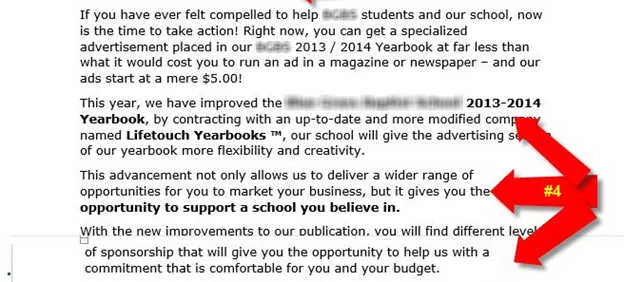
#4 Break the Rules on Purpose (Especially Spacing)
Let your inner English teacher take a nap for this part. Traditional paragraph structure is not your friend here. Dense walls of text scare readers away. Your goal isn’t literary perfection—it’s readability.
Break up your copy into short, punchy paragraphs. Use line breaks. Vary sentence lengths. The visual rhythm of your letter matters just as much as the words themselves. The easier it is to skim, the more likely it is to be read—and responded to.
(This is especially true about writing for an Internet blog or webpage. People’s eyes just can’t handle small print, big blocks of writing.)
So, break it down.
Vary the size of your paragraphs so that people reading your ads won’t get tired eyes and sore heads.
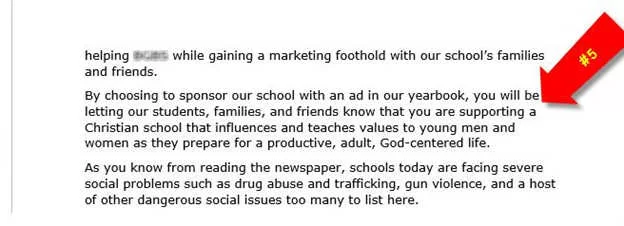
#5 Use Benefits and Reasons to Make Your Message Clear
One of the best things you can do before writing a single word of your private school fundraising letter is sit down and brainstorm.
Get input from students, parents, and staff. List out every single benefit of helping or contributing to your fundraiser. Don’t stop at three or four. Fill a page.
Why?
Because the more relevant benefits and reasons you can offer, the easier the writing will be—and the more compelling the final letter becomes.
I once reviewed a ten-page advertisement that was packed with persuasive power.
Almost every sentence in that document included a benefit or emotional trigger. That’s the kind of density that grabs attention and keeps people reading.
A successful fundraising letter should overflow with reasons to help.
Whether it’s supporting field trips, supplying classrooms, or funding athletics, your letter should make the reader feel like their support will make a tangible impact.
#6 Format Matters: Use Font to Guide the Eye
Your fundraising letter must be easy to read.
One overlooked but powerful way to do that?
Smart use of font formatting. Bold, italics, and underlining can be used (sparingly) to draw attention to key points or emotional triggers. If there’s a phrase or benefit you want to stand out—make it pop with formatting.
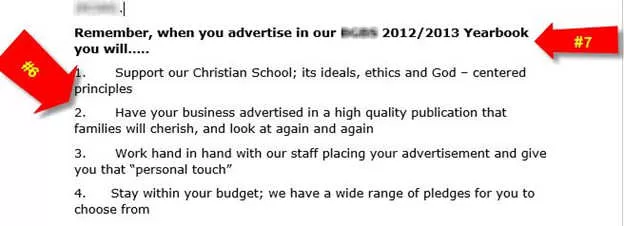
That said, consistency is key. Stick with one body font throughout—something simple like Arial, Times New Roman, or Verdana. Keep the size readable and avoid changing fonts mid-paragraph.
The only place to experiment?
The headline. Go big, go bold, and if you can, use a color like red to increase visibility.
Fonts like Impact are great for grabbing attention. (#7)
After all, if your headline doesn’t grab them in the first few seconds, the rest of the letter might never be read.
#6 Use Bullet Points to Highlight the Good Stuff
If you want people to actually see the benefits you’re offering, bullet points are your best friend. They help highlight key features and advantages in bite-sized, scannable format—perfect for busy parents and overworked donors.
Whenever possible, try to “dimensionalize” your bullets.
Don’t just list a feature.
Pair it with the benefit.
For example: instead of simply saying the yearbook cover is professionally printed, say, “The yearbook cover is professionally printed and looks great, so people who see your ad will know your business is in a serious, well-made publication—not some cheap flyer that ends up in the trash.”
See what we did there?
We transformed a feature into a meaningful benefit. That kind of clarity makes your private school fundraising letter much more persuasive.
Bullet points also help break up your letter visually. They give the reader a rest from big blocks of text, and guide their eyes to the parts you want to emphasize.
#8 Use a Call to Action (CTA) That Tells Them What to Do Next
No matter how good your letter is, it won’t convert unless you ask people to take the next step.
That’s what a call to action does. It tells them exactly what to do—whether that’s making a donation, sponsoring a page in the yearbook, or calling your school office to get involved.
Some copywriters argue the CTA is the second most important part of a letter, right after the headline.
And they’re not wrong.
Without it, your letter is just a friendly note that ends in silence.
Think about infomercials: “Call now!” “Order today!” They’re full of CTAs, and they work. That’s because repetition and clarity drive response. Don’t be shy—make your CTA bold, direct, and easy to follow.
If you can offer multiple ways for people to respond—phone, online, QR code—even better. Make it effortless, and you’ll get results.

The example above is about a local car dealership running ads on a Saturday morning—illustrates the power of multiple calls to action.
There were at least three or four different prompts urging viewers to take immediate steps.
And that brings us to something important I probably should’ve said earlier…
You might be thinking, “Isn’t this kind of sales language a little too slick for a private school fundraiser?” Or maybe even, “Is this ethical?”
I get it. The word “sales” can feel a bit greasy, especially when we’re talking about a place of learning. But here’s the truth: I’ve worked in several private schools, and they all relied on fundraising to survive—and thrive. Not just one campaign a year, but several. We’re talking yearbooks, bake sales, strawberry sales, cookbook drives, school festivals, candy bar blitzes—you name it.
Every school I’ve been part of had multiple fundraisers going on at once, often spearheaded by parents, teachers, or student groups. That’s not greed—it’s necessity.
So, let’s reframe the question.
Is it really unethical for a school to raise money for things like classroom supplies, student trips, team uniforms, or mission outreach?
Or is it more unethical to not provide those opportunities because the funds weren’t there?
Fundraising isn’t about manipulation—it’s about communication.
And when done with integrity and purpose, it’s one of the most important tools a private school has to fulfill its mission.

Let’s Get Real for a Moment About Your Private School Fundraising Letter
Do you want your students to go on memorable field trips that bring learning to life? Do your sports teams need updated uniforms?
Is your Senior Class dreaming of a graduation trip they’ll never forget?
Could your science classroom use new equipment or supplies?
Do you have students involved in mission work that aligns with your school’s values?
These aren’t luxury extras—they’re essential parts of the private school experience. And they all cost money.
That’s why having a persuasive private school fundraising letter is more than just a nice-to-have—it’s your best chance to turn good intentions into real contributions.
If your school is already running fundraisers—and let’s be honest, most are—why not make them as effective as possible?
A well-written private school fundraising letter can be the difference between scraping by and fully funding those important programs.
A compelling message can cut through the noise, reach your audience, and drive real support.
And let’s not forget: the fundraising companies you partner with want you to succeed too.
Trust me, the Golden Wrapper Candy Bar Company is rooting for you to move that chocolate like it’s gold. Your success is their success.
So yes, I am encouraging you to use smarter, more strategic messaging. Because when everyone benefits—your students, your school, your partners—that’s not sales pressure. That’s good communication.
Maximizing Your Call to Action
Now let’s shift gears and talk about how to use your call to action (#8) more effectively…
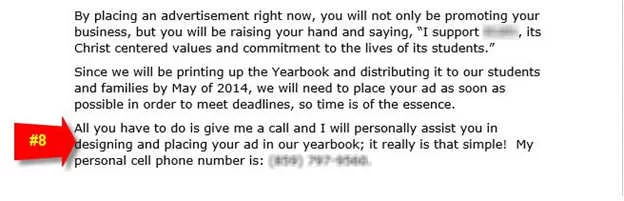
The first part of your CTA section should give readers one more compelling reason to donate or make a purchase.
This reason should go beyond what you’ve already said—maybe it connects emotionally, highlights urgency, or simply adds another benefit. Think of it as your final nudge.
Next, create a sense of urgency. People have great intentions, but if there’s no clear deadline, they’ll put off taking action.
That’s why every effective private school fundraising letter includes a time limit.
If your strawberry sale is only good during peak picking season—say so. If the senior class needs ticket money by next Friday, don’t just hint—spell it out.
Then comes the overt call to action. This is where you stop hinting and start directing. Tell your supporters exactly what you want them to do—whether it’s clicking a link, mailing a check, or placing an order.
And please, make it easy. If your fundraising partner offers a custom sales webpage, use it.
If parents can place orders by phone, email, or text, make those options crystal clear. The more convenient you make the process, the more likely they are to follow through.

Clear. Urgent. Actionable. That’s how you craft a CTA that converts.
The easier and more ways you can get people to order, the better off you’ll be.
#9 Closing ― Close out your letter professionally and always place contact and ordering information under your name. If you can add your signature do so because it adds a personal touch.
About Postscript (PS) Sections
Usually, copywriters like to use a postscript section in their copy. The reason is that you can remind people of the benefits you just mentioned, but the main reason copywriters is to sweeten the deal somehow.
If you can come up with an extra benefit or treat to go along with your initial offer, put it in the postscript (PS) section.
Lists of Books that can Help Your Fundraising
If you want to learn more about how to write private school fundraising letters or any other type of persuasive message, I’ve put together a list of resources that you can draw on.
These resources deal with the art of copywriting however, you can adapt these to your fundraising communications as well.
The Ultimate Sales Letter by Dan Kennedy ― This book is a great introductory text that will give you all of the basics you need to craft a persuasive message of any kind. Dan Kennedy is a master marketer that commands $25,000 for a sales letter from his clients. You can get it used from Amazon for a lark.
How to Write Successful Fundraising Letters by Mal Warwick ― Here’s a book that deals directly with writing private school fundraising letters and actually gives you examples to work with. In the world of copywriting, “swiping” or the practice of using other people’s advertisements and letters as a template is common practice. So there are quite a few examples you can swipe and quickly adapt to your fundraising efforts.
The Fundraiser’s Guide to Irresistible Communications by Jeff Brooks ― When other good copywriters recommend a book of this nature, you better believe it will get results. Not only does Jeff Brooks give you great fundraising ideas, but he also shows you how to design them for a better response. Once again, you can get this book from Amazon for free.
Conclusion To Private School Fundraising Letter
Well, I am an advertising copywriter myself, so if you need help with this task, please feel free to contact me. I’ll be happy to talk to you and give you some free tips on how you can make your next fundraiser more profitable.
Hey, if you got some real value from this post, I’d love to hear about it. Please leave a comment below, it would really make my day.
To Your School’s Continued Success!
Mark :Elmo Ellis
Updated: June 24th, 2025
Richmond, KY – Next to the Valley View Ferry
ElmoCopy.com