




High-converting coaching copy isn’t a luxury—it’s the backbone of your brand.
So, if you think you can build a six-figure coaching business with cheap Fiverr copy, think again.
You don’t need a magic viral quote to attract high-end prospects—you need a crystal-clear message. One that grabs your ideal clients by the eyeballs and makes them say, “Hell yeah, I need this!”
The problem with most coaches is that they are drowning in content that lacks clarity. They’ve got piles of content coming out their asses, but no converting copy to land them their dream clients.
This post is about that very thing. Writing clear messages that bring demand, higher prices, and more wealthy clients.
So, now that we have clarified our goal, let’s dig in.
Selling with Words Isn’t Manipulation—It’s Communication
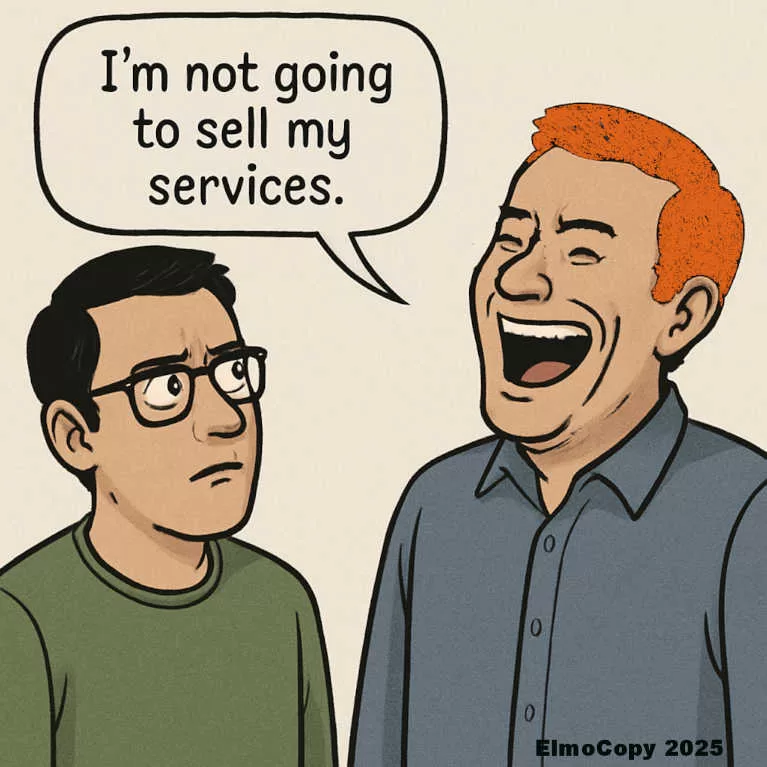
I recently had a chat with a young dude who wanted to be the next Tony Robbins. He was buzzing with excitement about his new coaching business, so I mentioned that I was a copywriter.
Told him I was pretty good at selling things with words—and that maybe, just maybe, he could use my help.
That’s when he slammed on the brakes.
“Oh no!” he blurted. “I’m not gonna sell my business like some sleazy used car at a dealership. I’m building my empire with honesty and kindness!”
I blinked. “So… you’re not going to sell or market your services?”
“Nope. Too sleazy for me,” he said, grinning like he’d just cracked the Da Vinci Code.
“Well, good luck with all that,” I laughed—and veered off into the sunset.
Here’s the thing: Goober here has the same mindset a lot of you have—that you can build a business without actually selling it.
If you think that for even one second… you might want to stop reading now.
Because I’ll take it a step further: selling with words is vital to your business’s survival.
If you’re not going to sell it, (especially with printed words) you might as well forget about it.
Period. End of statement.

Content ≠ Conversion
Let’s talk about the massive elephant in the room: the content treadmill. A lot of business coaches and content copywriters get stuck in the muck of this cycle.
Been there, done that, got the burnout badge.
You’re posting quotes, sharing tips and tricks, and trying to add value—but you’re getting nowhere fast.
And here’s the rub:
You’re stuck because content gets you seen—but messaging gets you clients.

The Wrong and the Right Way to Message
I spend a lot of time on LinkedIn, and I see tons of posts that are completely irrelevant—photos of people in sexy outfits, paired with short, meaningless blurbs.
And guess what?
A lot of those posts rack up tons of followers, comments, and reactions.
Well, great… but are they actually converting?
Most of what you see on social media these days? Pure non-growth noise.
(Yep—non-growth is exactly what you’ll get from reading it. You’d be better off picking up a book by a high achiever in your industry.)
Another thing I see way too often: posts that are all sizzle and no steak.
Flashy. Loud. Hollow.
So skip all of the crap; Grab a book with real value and solid reviews instead.
Deploy Your Core Message
So, you need to deploy your core message. It is one sentence that explains who you are trying to help and why they should choose you.
To make it clear, the two points you need to get get across to your prospects and readers are:
- Who you are focused on helping
- What benefit they can get from you
I recently came across two separate articles—each by a successful author—and both shared the same golden rule: Know exactly what you’re writing about, and who you’re writing it for.
And you must, must, must figure that out before you write a single word.

How to Write a Core Message
These are what I like to refer to a $10k sentences.
What are $10K sentences?
These are sentences that boil your offer down, revealing to your prospects the biggest benefit they’ll get.
That’s right…JUST ONE…CLEAR…SENTENCE.
So, how do you write a $10K sentence?
Make it Clear
You want to get to the meat without sautéed mushrooms and onions all over it.
You want a message that screams, ” Give me the freakin’ steak – No more Jell-O for me, mom!
Here are some examples:
Weak: “I help people become the best version of themselves.” (Congratulations. So does my dog trainer.)
See how vague that is?
It doesn’t tell your readers what you do or what the benefit is.
Strong: “I help burnt-out executives rebuild their energy and lead with confidence in 90 days.”
It Must be Relevant
A core sentence must speak directly to the pain they are experiencing. So, you’ll need to know what is keeping your followers up at night.
Weak: “I teach mindset transformation.”
Notice how simple that statement is? Yep, it gets right to the point.
Strong: “I help new managers lead without doubt or second-guessing.”
Add a Dash of Emotion
You need to add some punch to what you write. Don’t expect your readers to love what you write when it’s as boring has hell.
Let me give you a for instance:
Weak: “I offer coaching programs for women.”
Yep, that’s about as boring as a baloney sammich without mayo.
Strong: “I help overwhelmed moms reclaim their identity—and build a life beyond laundry and leftovers.”
Now, we’re cooking with gas!!!
This sentence not only delivers the benefit, but connects with popping wit.
Top it Off with Authority (If You Can)
If you can back up your statement(s) with some serious proof, then lay it on. Nothing speaks louder that solid, provable results.
So, if your sentence can earn it’s keep with backed up results, then lay it on!
Weak: “I help people start businesses.”
Your reader: (Yawn) ” I’ll watch some cat videos.”
Strong: “I’ve helped 127 women turn side hustles into full-time income in under a year.”
You reader: Wow, how in the hell did she do that???
See the difference? One feels like wet toilet paper.
The other beckons like a window to an alternate universe – full of possibilities.
If your sentence doesn’t slap skin —it’s time to rewrite it.
And now for the Bonus Section:
The Copywriters Secret Weapon for Writing Attention Grabbing Sentences
This is a copywriter’s trick you can use.
It’s usually used for crafting eye- grabbing headlines, but you can also use it for sentences, too.
These are the 4 U’s of writing a powerful statement:
Your power sentence must be Useful, Urgent, Unique, and Ultra-Specific.
Sometimes you won’t be able to use all four. In the case of writing $10K sentences, I’d ditch the unique angle.
Why? Because when you’re writing a headline, you’ll need to check the search engines to see if you’re using the same one as everyone else.
You wouldn’t want your blog post headline to be the same as 50 other posts.
But with sentences, it doesn’t matter as much.
So, here are the 4 U’s:
So, here are the 4 U’s:
1. Useful: Does the headline communicate a clear benefit or solution for the reader? It should answer the question, “What’s in it for me?”
Example: “Here’s 4 lightning-fast marketing hacks filthy rich personal trainers never share.”
2. Urgent: Does the headline create a sense of immediacy that encourages action? This could involve deadlines or a reference to a pressing problem.
Example: “Here’s how to immediately skyrocket your coaching to six-figures using email.”
3. Unique: Does your sentence stand out and grab your reader’s attention? If you can come up with a different approach, you might be able to pull it off.
Example: “If people don’t get what you do in five seconds, they won’t pay you in five years.”
4. Ultra-Specific: There are 3 different things you can do to write sentences that focus on a subject like a laser. Just think of 3 “W’s” while you write – who, what, and where. And if you’re talking about any proof statements use numbers. (Don’t round them off keep them real looking.)
Example: “I help seasoned business coaches clarify their core message so they can raise their rates, stop attracting broke leads, and finally enjoy marketing again.”
So, if you can hit a few of the 4 U’s in a single section, bravo!
You’ll suck in their attention like a dry sponge.
Your goal isn’t to sound clever, but to make your readers feel compelled to keep reading, so you can turn their curiosity into conversions.
And for the record, coaches don’t set out to confuse the hell out of their audiences. In their quest to help and connect to their herd, things seem to go sideways.
Here are the biggest traps they seem to fall into:
Generic messages. If you’re pitch is, ” I help people live their best lives.” you can hang it up. It is too vague and forgettable; it doesn’t tell anyone why you’re the coach they need.
Too many offers. If you’ve got a big wad of packages, mastermind sessions, and mini-courses it is no bueno. Your crowd will get confused because they won’t know where to start.
Another big error in their copy is forgetting the outcome. If you don’t show followers how your actions lead to their goals, they’ll say, “goodbye”.
To sum up the problem: you want simple copy that is not confusing. Making your audience guess will make them hesitate.
And that, my friend is a deal-breaker. In a crowded marketplace you want to display confidence and clarity. And you must do that from the very first word they read.
How Copywriters Save the Day
I’m sure you’re thinking this is going to be a pitch for my services.
Nope. I’m already overloaded with work, so I don’t have time to pull that junk on you.
I just want to open your mind to the possibility of hiring one. (Can you dig it? I knew you could.)
If you don’t know much about copywriters or copywriting, let me begin your education.
First of all, copywriters sell with words.
Remember earlier when I told you that selling was essential to your business? (I also mentioned you might want to forget about having a coaching business if you don’t like selling.)
Well, copywriting — and copywriters — can make the chore of selling much easier for you.
Let’s say you want to sell your services to a group of people in a certain city, like Cincinnati, Ohio. You could hire a direct response copywriter to generate leads for your coaching services. He could write a high-converting sales letter for you to send to a targeted group of people. (He could even access a list of executives who might be interested in your services.)
If he’s a reputable copywriter and has a good list to work with, that letter could convert at a 3% to 5% rate. That’s 30 to 50 people responding to your offer.
For a coaching business, that’s significant. In fact, that’s pretty darn good.
Not only would you get a truckload of conversions, but you’d also save a lot of time trying to write your own copy. And you could do the same with a magazine ad, a website, or search engine ads.
Sure, you could learn how to write your own copy in a short period of time — but I wouldn’t gamble too much on that.
It takes time to master good copywriting.
And if you want to be an outstanding business coach, you’ll want to spend your time coaching — not writing copy.
So, in my humble opinion, hire a pro so you can focus on your business.
Conclusion
I hope this gives you a clearer idea of how high-converting copy can help your coaching business grow.
Let’s face it—you could be Mother Teresa and discover the cure for cancer, but if your words don’t sell, well… get used to staring at an empty bank account.
If you want to move the money ball down the field and score, you need a crystal-clear message—one that pulls in dream clients like a magnet and makes your life a whole lot easier.
My opinion? Don’t waste time putting out vague content. Either hire a copywriter who can help you or learn how to write strong copy yourself.
Here’s the final takeaway: every time your copy sells for you, it’s like sending out a team of salespeople to work on your behalf.
And that sure beats the crap out of going door-to-door or cold-calling all day.
Stay frosty, my friends.