




Getting coaching clients is what you’re thinking about… a lot.
I’m a mind reader. Don’t believe me?
Here’s what else you’re thinking:
If getting coaching clients were as simple as posting more content, I’d be booked solid by now.
My insights are valuable, the writing is spot on, and I’ve been posting regularly.
Not only that, the engagement and feedback from readers are good, and everyone tells me my info is helping them.
So what the hell?
Told ya I could read your mind.
You’re moving in this game like a master, but your dance card is empty.
Yep, you’re not getting any clients, and it sucks. (There, I said it.)
Sure, you’re getting attention, but apparently it’s from zombies, because the only client you’ve got is your momma.
And that kind of silence has a way of creeping into your confidence, doesn’t it?
At some point, the internal dialogue kicks in.
I know I’m good at this. I help people all the time. So why does selling feel so awkward and off-brand?
Or maybe it sounds more like this:
I didn’t become a coach to play internet carnival barker, so why does marketing make me feel vaguely slimy?
That frustration doesn’t mean you’re failing. It just means you’re stuck in a system that keeps rewarding visibility while quietly dodging commitment.
Here’s the promise: the issue isn’t a lack of tactics, louder messaging, or other “proven” strategies. The real problem is simpler than that, and once you see it, a lot of the confusion clears fast.
Because the fact of the matter is this: coaching clients aren’t pursued and captured like wild game.
Coaching clients are… created.
What do I mean by that?
Keep reading, and I’ll pull back the veil on this somewhat secretive subject.

The Frustration No One Wants to Admit Out Loud
You’ve been doing everything you were told would work.
You’re showing up consistently and putting real thought into your content. The ideas aren’t recycled fluff, and the writing doesn’t feel slapped together at midnight just to keep the algorithm happy. People like it. They tell you it’s helpful. Some even say it’s exactly what they needed to hear.
And yet, clients aren’t lining up.
Your posts collect likes, maybe a comment or two, and then quietly disappear down the feed. The engagement looks decent enough to keep hope alive, but not strong enough to turn into actual conversations that lead anywhere.
Somewhere in the middle of all that, selling starts to feel… off.
Not sleazy, exactly. Just awkward. Like you didn’t become a coach to turn into a walking call-to-action, but somehow that’s what the internet keeps nudging you toward. So you hesitate. You soften the language. You focus on being helpful instead.
Recognition first. Always.
Because none of this means you’re lazy, untalented, or doing it wrong. It just means something important hasn’t clicked yet.

http://childpsychiatryassociates.com/treatment-team/kent-kunze/ The Question You Don’t Want to Ask at 11:47 PM
There’s also a quieter frustration underneath all of this that doesn’t get talked about much.
You start wondering whether the problem is the market instead of the message. Maybe coaches just don’t buy and people are broke. Or, perhaps, everyone is “waiting until next quarter.” Those explanations feel comforting because they move the problem safely outside your control.
But late at night, when you’re not scrolling or planning or tweaking headlines, another thought tends to surface.
If someone landed on your site today, could they clearly explain what problem you solve without rereading it twice?
That question has nothing to do with effort. It has everything to do with clarity.
Most coaches aren’t confused about what they do. They’re confused about how to talk about it in a way that creates movement instead of polite nodding. So, they hedge. They soften. They explain instead of decide.
That’s not a motivation issue.
It’s a translation issue.
And the longer it goes unaddressed, the more it quietly erodes confidence. Not enough to make you quit, but enough to make you hesitate right when decisiveness matters most.
Why Most Advice Quietly Fails
This is the part listicles can’t touch.
Most advice assumes clarity is already handled. It skips straight to tactics and treats execution like the missing ingredient, as if more activity will magically correct a fuzzy message.
It won’t.
Tactics without clarity don’t convert. They amplify whatever message you already have, and if that message is vague or overly polite, all you’re doing is broadcasting confusion at a higher volume.
Leads aren’t clients either, even though advice often pretends they are. A lead is interested. A client has decided. Those are two different psychological states, and no amount of engagement bridges that gap by itself.
Attention gets confused for commitment all the time. Likes and comments feel like momentum, but they don’t require a decision. Commitment does, and content that avoids tension rarely creates it.
Funnels don’t fix confusion, no matter how elegant the setup looks on a whiteboard. A funnel can move people through a story, but it can’t clarify the story for you. If the message is unclear, the system just distributes that uncertainty more efficiently.
None of this is an attack. It’s just calm truth.
Advice That Treats Motion as the Cure
Another reason most advice fails is that it treats symptoms instead of causes.
It notices that people aren’t getting clients and immediately prescribes activity. More content. More visibility. More frequency. As if the issue is volume rather than precision.
That advice works beautifully for people who already have clarity. For everyone else, it turns marketing into a treadmill. You’re moving constantly, sweating profusely, and somehow ending up in the same place week after week.
The problem is that clarity doesn’t scale automatically.
You don’t get clearer by posting more. You get clearer by making decisions about who you’re not talking to, which problems you’re not addressing, and which outcomes you’re not promising.
Most advice avoids that part because it’s uncomfortable. It requires exclusion or requires saying no.
Also, it requires risking smaller numbers in exchange for stronger signals.
So instead, the advice leans on universals.
Be consistent.
Add value.
Show up.
None of those are wrong. They’re just incomplete.
And incomplete advice, when followed diligently, creates exactly the situation you’re in now: visible, busy, respected… and still waiting. in the same place week after week.
The problem is that clarity doesn’t scale automatically.
You don’t get clearer by posting more. You get clearer by making decisions about who you’re not talking to, which problems you’re not addressing, and which outcomes you’re not promising.
Most advice avoids that part because it’s uncomfortable. It requires exclusion. It requires saying no. It requires risking smaller numbers in exchange for stronger signals.
So instead, the advice leans on universals. Be consistent. Add value. Show up.
None of those are wrong. They’re just incomplete.
And incomplete advice, when followed diligently, creates exactly the situation you’re in now: visible, busy, respected… and still waiting.
The Model That Actually Explains What’s Happening
Clients don’t appear because you stacked the right tactics in the right order.
They show up because something clicks.
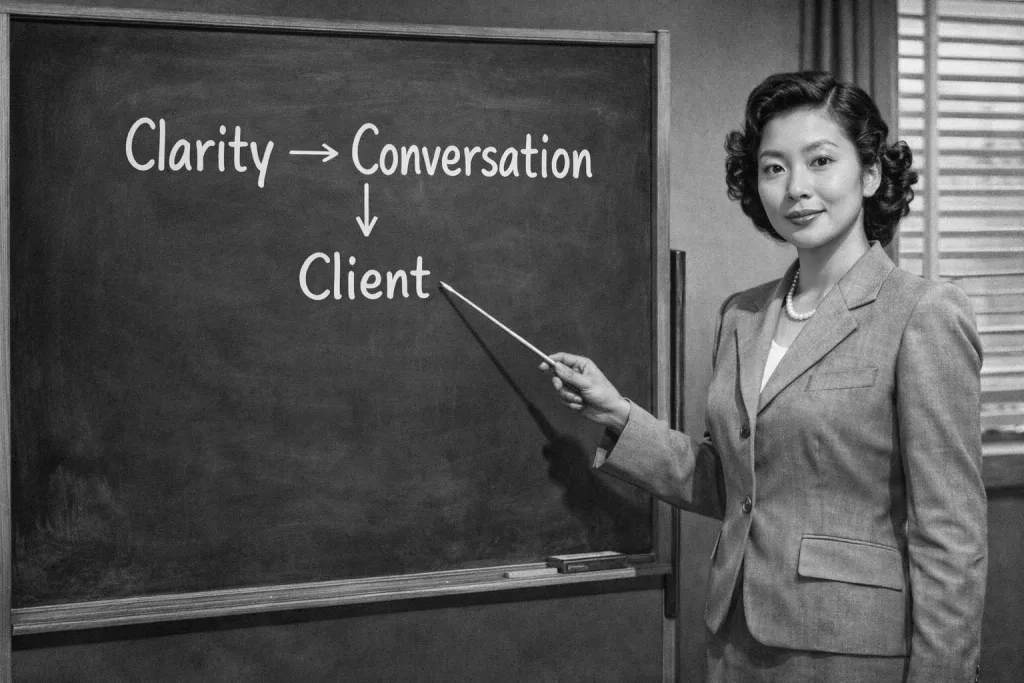
That click follows a simple sequence:
Clarity → Conversation → Client
Marketing gets you noticed. That’s its job. It earns you a moment of attention, nothing more and nothing less.
Copy gives that moment meaning. It turns your internal understanding into language someone else can recognize without effort. When it works, it doesn’t persuade so much as it names what the reader already feels.
Conversation is where the real work happens.
That’s where nuance shows up, context matters, and trust forms naturally. When clarity is right, those conversations don’t feel like selling – they feel like alignment.
That’s the “aha” most advice never reaches, because it’s too busy counting posts and tracking clicks.
Why Conversations Change When Clarity Does
What’s often missed here is that conversation doesn’t start after clarity. It starts because of it.
When clarity is weak, conversations stay surface-level. People ask generic questions. They disappear mid-thread. They thank you and move on.
When clarity is strong, conversations deepen almost immediately.
People skip small talk. They get specific.
They tell you what they’re stuck on without being prompted.
That difference isn’t accidental.
Clarity gives people permission to be honest. It tells them you understand the terrain well enough to handle the real problem, not just the socially acceptable version of it.
That’s why copy sits between marketing and conversation so neatly. It’s the bridge. It takes attention and turns it into relevance. Without it, marketing stays noisy and conversations stay shallow.
Once you see that sequence clearly, it becomes obvious why stacking tactics never fixed the issue. You were trying to force movement at the wrong stage.
What Clear Messaging Actually Looks Like
Here’s the difference most people miss.
“Helping coaches grow with aligned content and offers” sounds fine, but it asks the reader to translate. Clear messaging doesn’t require interpretation.
“I help coaches who are posting consistently but still not getting clients fix the words that are stalling their sales” does the work for them. Same intelligence. Different outcome.
Content that starts conversations doesn’t end with applause. It creates a pause.
Something like, “Most coaches don’t struggle because they lack ideas. They struggle because their message sounds helpful instead of decisive.” That sentence doesn’t teach. It invites reflection, and reflection is where conversations begin.
Clients are created quietly. Someone feels recognized, so they reach out and a real exchange happens. The problem sharpens. The next step becomes obvious. No chasing. No pressure. Just timing and clarity meeting in the middle.
Depth beats breadth every time.
The Next Step, If This Is Landing
If this feels uncomfortably familiar, it’s because you’re not missing effort.
You’re missing translation.
If you want help turning your ideas into words that start real client conversations, there’s a small $27 resource that walks you through exactly that.
No hype or drama.
Just a clear path from thought to conversation.
It’s there when you’re ready.
Why This One Post Pulls More Weight Than It Looks Like
This isn’t just another article.
It targets a real keyword without sounding like it was written for robots. It establishes authority without posturing. It separates you from tactic-first noise and feeds your email list with people who already agree with you.
It also quietly pre-sells the $27 resource and gives you a dozen smaller pieces you can spin off later.
That’s leverage.
What to Do Right Now
Before you do anything, start small.
Write a working title.
Draft the first two frustration paragraphs.
Craft one clean sentence explaining why most advice fails and if those three land, the rest stops feeling hard.
Once that happens, everything else tends to fall into place a lot faster than you were led to believe.
Why These Three Steps Matter More Than They Look
Those steps matter because they force clarity before content.
A working title exposes whether you actually know what this piece is about. The first two paragraphs reveal whether you’re speaking to a real frustration or hiding behind abstraction. The single sentence about why advice fails tells you whether you understand the root problem or are still circling the surface.
If any of those feel slippery, that’s information. It doesn’t mean you’re bad at this. It means you’ve found the spot where clarity needs more attention.
Do that work once, and future pieces get easier. Not because you’ve found a trick, but because you’re no longer starting from fog.
So, Where Does This Leave You?
If there’s a single shift worth holding onto, it’s this one.
You don’t need more ideas, platforms, or confidence.
What you need is clarity strong enough to carry a conversation.
Most advice skips that step because it’s quieter than tactics and harder to package. But it’s also the part that actually changes outcomes. When the message is clear, the right people recognize themselves without being pushed.
Conversations stop feeling forced and selling stops feeling awkward. Movement starts happening without theatrics.
That doesn’t mean everything suddenly becomes easy. It just becomes cleaner. You stop mistaking activity for progress and start paying attention to alignment instead. And once that clicks, a lot of the pressure you’ve been carrying quietly lets go.
This isn’t about doing more.
It’s about saying the right thing, in the right way, to the right problem.
Everything else tends to follow from there.
Hey, did you like this post? Please leave comment in the section below, it will really make my day.