



Damn.
It was almost midnight and Marcus sat staring at his laptop.
His three-month content calendar was beating down his will to write.
Yeah, he spent a lot of time putting that sucker together, planning out every day’s writing. Now it almost felt like an adversary.
He rubbed his eyes.
Usually, the words seemed to flow, but tonight was different. He was behind schedule and all he could think about was catching up.
Here he was, a business coach who preached organized productivity, and he was stalled – big time.
“I feel like a constipated walrus,” he mumbled.
He had plenty to say, but the pressure to produce was killing his creativity and productivity.
Yep, the content calendar he had carefully built was supposed to make writing easier. Instead, it was slowly strangling his creativity.
And Marcus isn’t alone.
Thousands of coaches are trapped in the same cycle, spending more time managing their content systems than actually creating content.
The Great Content Calendar Obsession
Coaches like Marcus aren’t alone.
As a copywriter for coaches, I’ve seen many of them chasing the same dream: Build the perfect content calendar and success will appear.
Yeah, right…Not happening.
The problem is that we’re all bent on the idea that content planning is the secret to growth.
- Plan your posts weeks in advance
- Organize them into themed buckets
- Batch the work
- Schedule everything
- Rince and repeat
Ugh!
Now, when you look at that list, what do you notice? Yep, there’s a whole lot of work on the front end. And let’s be honest. Most of it is about as enjoyable as a root canal performed with a rusty spoon.
There. I said it.
Now before the Content Calendar Police kick down my door, let me clarify something.
I’m not against planning.
In fact, some planning is essential. The best content copywriters I know won’t work with a client who has no strategy whatsoever.
But somewhere along the way, planning stopped being a tool and became an obsession.
Coaches build thirty-day plans…
Then sixty-day plans…
Annual content strategies that look like a military logistics team built them…
Coaches can spend hours organizing, categorizing, color-coding, scheduling, and optimizing.
And guess what?
They still struggle to get noticed, attract clients. and gain traction.
Which raises a rather uncomfortable question.
If content calendars are the answer, why are so many coaches still invisible?
Nobody Hires the Coach With the Most Posts
Think for a second. When was the last time you hired someone because they showed up in your feed every day?
Yeah, me neither.
I know a coach — sharp dude, competent, good at what he does. He was posting like crazy; reels, carousels, quotes on sunsets. Engagement was okay, occasional comments, people nodding along.
But his revenue was dead. No moola flowing in.
Not a single client from months of that grind.
Here’s the thing: being a “postaholic” doesn’t build trust. It just builds noise.
Loud, busy, unclear noise.
People don’t hire the loudest mouth in the room. They hire the one who gets them. The one who already knew what the problem was before you finished explaining it. The pro who’s confident and certain about how to fix whatever’s broken.
That’s what gets people to plunk down their money and hire you.
Not your post count.
So stop. Take a breath and ask yourself: does my content actually say something valuable? Does my tribe feel like I’m the person for their specific problem?
Because if it doesn’t, you could post every hour and still be waiting on that first client.
The Weird Reason Your Content Isn’t Converting
At this point, some of you are thinking:
“Okay, Elmo. If my content calendar isn’t the answer, then what’s the problem?”
Glad you asked, Bochombo.
Because the issue usually isn’t effort.
Most coaches are already busting their asses.
They’re spending hours creating posts.
Recording videos.
Tweaking captions at midnight like that’s gonna be the thing that finally moves the needle.
And after a while, you start quietly wondering why you became a coach in the first place.
But here’s the real problem:
The message isn’t landing.
Not because you’re lazy.
Not because the algorithm hates you.
Because the content is vague, disconnected, and if we’re being honest…forgettable.
Big “B” Boring.
Go scroll through any coaching account right now and you’ll see the same stuff on repeat:
- Safe opinions nobody could disagree with
- Predictable “here are my 5 tips” advice
- Motivational clichés your grandma has on a refrigerator magnet
- Polished, corporate-sounding language that makes you sound like a brochure
Nobody remembers any of it.
And more importantly, nobody buys from it.
Here’s what that actually is:
A positioning problem, not a posting problem.
People don’t buy posts.
They buy from someone who gets them.
Someone who understands what they’re going through and who makes them think:
“Damn. That’s exactly what I’ve been dealing with.”
That moment, that little gut punch of recognition, is when content starts converting.
It’s the moment your prospect feels understood, and the moment they stop seeing you as another coach and start seeing you as their coach.
That’s when trust and authority starts and clients start paying attention.
Everything else?
That’s just content being fed into the algorithm’s wood chipper.
How Coaches Accidentally Train Their Audience to Ignore Them
Here’s something that might sting a little: Your content might not be building attention.
Matter of fact, it might be training people to ignore you.
Think about what happens when someone posts the same type of content day after day.
Another motivational quote, the same old “you’ve got this” post, or a generic tip list.
Blech!
At first, people notice it…Then they recognize it…They predict it…And then they scroll right past it.
Listen, the human brain is wired for novelty, contrast, and meaning.
The second your content becomes predictable, your audience starts tuning out.
Not because they dislike you or because your advice is bad.
It’s because they’ve seen it before.
(It’s kinda like your Aunt Melba telling the same family story for the fifteenth time at dinner. Eventually, everybody starts reaching for the potato salad.)
The mistake I’ve been hammering throughout this article is pretty simple:
Most coaches believe the equation looks like this:
More Posts = More Authority
But that’s not how it works. You can drop tips until the cows come home and still be invisible.
Why?
Because people don’t remember information, they remember perspective. They remember the person who made them think, or challenged an assumption. A coach who said something they hadn’t heard a thousand times already.
If you’re wondering what makes content memorable in the first place, I break that down in Why Coaches Stay Broke Posting Content Nobody Remembers, where I explain why memorable messaging consistently beats endless posting.
Strong messaging gives your audience something to anticipate.
They start wondering:
“What’s this coach going to say next?”
“What’s their take on this?”
“How are they going to frame this problem?”
That’s when content stops feeling like content and starts feeling like a conversation. And when that happens, followers become readers, readers become prospects, and prospects become clients.
BOOM!
That’s the game you want to play.
The Calendar Was Never the Problem
OK, before you throw your planner out the window, I’m not declaring war on content calendars. I use one myself, and I know copywriters who flat-out refuse to work with clients who don’t have one. So no, they’re not evil – they’re just tools. Useful, necessary, completely overrated tools.
The problem isn’t the calendar.
The problem is what coaches expect it to do.
A calendar can tell you when to post, or it can remind you to call a client on Monday. It can even shuffle your writing days around when life gets weird.
Very helpful…Love it…Ten out of ten on the score card.
But here’s what it cannot do:
Tell you what people will remember.
And that, right there, is where coaches get into trouble, because hey confuse having a schedule with having a message. They organize their content like a Swiss watch and then wonder why nobody’s buying. The coaches who win aren’t winning because they have prettier spreadsheets. They’re winning because somebody reads their content and it sticks.
It makes them stop and think:
“Who is this person?”
“Why haven’t I heard this before?”
“Why does this make so much sense?”
That’s not a scheduling problem.
That’s a messaging problem, because organization isn’t the solution. No color-coded, perfectly planned, synced-across-all-devices calendar is going to fix that.
The calendar was never the problem.
The expectation of what it could do?
That was the problem.
The Coaches Who Win Play a Different Game
Many coaches obsess over when to post.
The ones who break through obsess over what they stand for.
Boom.
There it is.
As I’ve already said, average coaches tend to worry about:
- Frequency
- Consistency
- Scheduling
- Batching
- Production-line content
How many posts they published this month, how many reels they recorded, or how many emails they sent.
Worry, worry, worry.
And don’t get me wrong. The content is often well-written, clean, professional, and polished.
But it’s also forgettable.
The coaches who win play a different game.
Successful coaches focus on perspective, offering fresh ways to look at familiar problems and challenging assumptions.
Instead of repeating what everyone else is saying, they introduce ideas people haven’t heard a thousand times before and aren’t afraid to stand for something.
Strong opinions.
Clear beliefs.
Convictions.
A genuine point of view.
Rather than trying to appeal to everyone with a pulse, their goal is to connect deeply with the right people and earn trust along the way.
Trust built through stories, honesty, vulnerability, and experiences their audience can see themselves in.
And when they show up, people pay attention.
Not because they’re posting more, but because they’re saying something worth hearing.
That’s when prospects start thinking:
“Finally.”
“Somebody gets it.”
“This is exactly what I’ve been struggling with.”
People don’t hire schedulers.
They hire coaches whose ideas stick.
Think Velcro instead of planners.
The coaches attracting clients aren’t creating more content.
They’re creating more impact.
And that’s the game you need to play if you want to win.
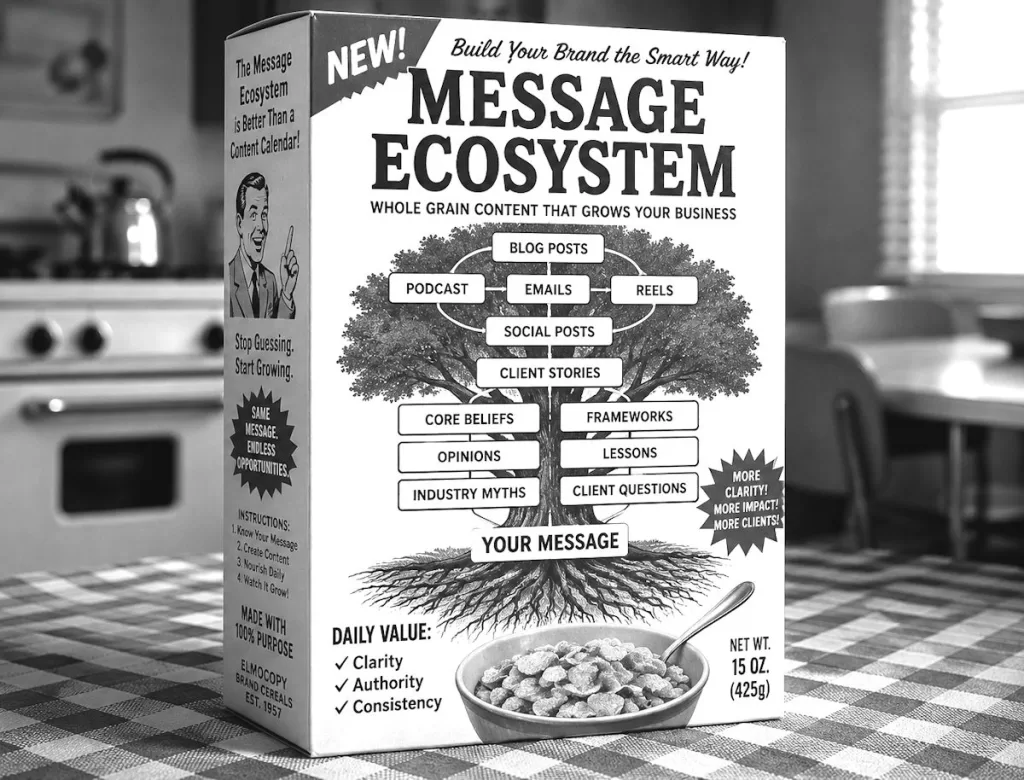
Build a Message Ecosystem Instead
So if a content calendar isn’t the answer, what is?
Simple – build a message ecosystem.
A lot of coaches build their businesses around publishing content on a schedule.
However, the best one’s build their enterprises around ideas.
And this is a real game changer.
So, don’t focus on posting next Tuesday at 9 AM. Focus on building a collection of ideas that are evergreen.
Start thinking about your core beliefs. What do you know about your industry that most people get wrong?
What ideals are you ready to die for?
Once you figure that out, start collecting stories.
Stories about your life…
Tales from your clients…
Failures, breakthroughs, embarrassing situations and unexpected victories.
The reason you’re using stories like this is because people can see themselves in them. You can also add your opinions to them reinforcing your core beliefs. Stuff that’ll make people back up for a second and think, “Holy crap, he’s been reading my mail!”
So, how do you get these content ideas?
Pay attention to what your clients are saying. Listen to their objections, questions, confessions, and their they celebrate.
And you know what?
They’re gonna be tomorrow’s content. Yep, you can use their experiences to reinforce what you’re putting out.
So when you build this message ecosystem, you won’t have to think too much about what to write. Just grab another story and let the good times roll. Your calendar then becomes what it was always meant to be — a tool, not a tyrant.
Doesn’t this beat the hell out of what you’ve been doing?
The Day Marcus Stopped Writing for His Calendar
One morning, Marcus did something he hadn’t done in months — he ignored his freakin’ calendar. Of course, he didn’t throw it away, he just decided to shelve it for awhile.
Instead of asking himself, “What am I supposed to put out today?”
He thought, “What do my readers need to hear?”
Once he realized that, the pressure disappeared, the clouds parted and the sun’s rays beamed down upon his laptop.
(Well, OK, I’m exaggerating a bit, but you get the drift.)
Yep, the spreadsheet stopped calling the shots for him. So, instead of trying to keep pace with a schedule, Marcus started giving his crowd what they wanted.
Conversations, questions, mistakes, and lessons he learned the hard way. All of those ideas seemed to come easily to him.
And you know what?
None of it was on the calendar, and all of it was important to his readers.
The words came fast, the writing felt like it was from the heart, and the ideas flowed into his copy.
And that’s when the content calendar quietly moved back to where it belonged.
In the toolbox.
Waiting until it was needed.
Marcus was behind the wheel again.
The calendar was finally riding in the passenger seat.
The Real Goal Was Never a Perfect Content Calendar
OK, let’s be honest, content calendars aren’t going anywhere.
Yeah, they can be a pain in the ass, but let’s face it, planning is useful.
Planning and organization are important and useful.
But along the way, coaches started believing that a perfect, organized calendar was the magic spell that would produce a memorable message.
Well, let me tell you…It won’t!
A calendar is great for:
• Reminding you to post
• Organizing ideas
• Keeping track of what you’ve already written
• Displaying your content goals
• Keeping you consistent
However a content calendar cannot:
• Create posts
• Make people care
• Help you to be unforgettable
You’re still going to have to do that stuff.
So, stop chasing the perfect content calendar and stop trying to out-post everyone.
Quit measuring your success by how many pieces of content you publish each month.
Ask yourself this:
Did I say something worth remembering?
Am I challenging assumptions?
Will I tell a story that made someone feel understood?
Did I give people a reason to come back tomorrow?
Because at the end of the day, nobody hires the coach with the prettiest spreadsheet.
They hire the one they remember.
Build the calendar if it helps.
Ignore it if it doesn’t.
Just don’t ever confuse managing content with creating messages that stick.
Think Velcro instead of planners.
Ready to Put Your Message to Work?
Once you’ve built a message people actually remember, the next step is turning readers into subscribers and subscribers into clients.
That’s where having the right tools makes all the difference.
I use Systeme.io because it lets coaches build landing pages, capture leads, create email campaigns, and sell digital products without juggling half a dozen different platforms.
If you’re serious about growing your coaching business, it’s worth taking a look.
Please let me know how this post has impacted you I really appreciate your comments and it would really make my day.